Cryptocurrency Adoption Patterns in Virtual Table Game Payout Systems
Mia Friedrich · Aug 21, 2026
Cryptocurrency Adoption Patterns in Virtual Table Game Payout Systems
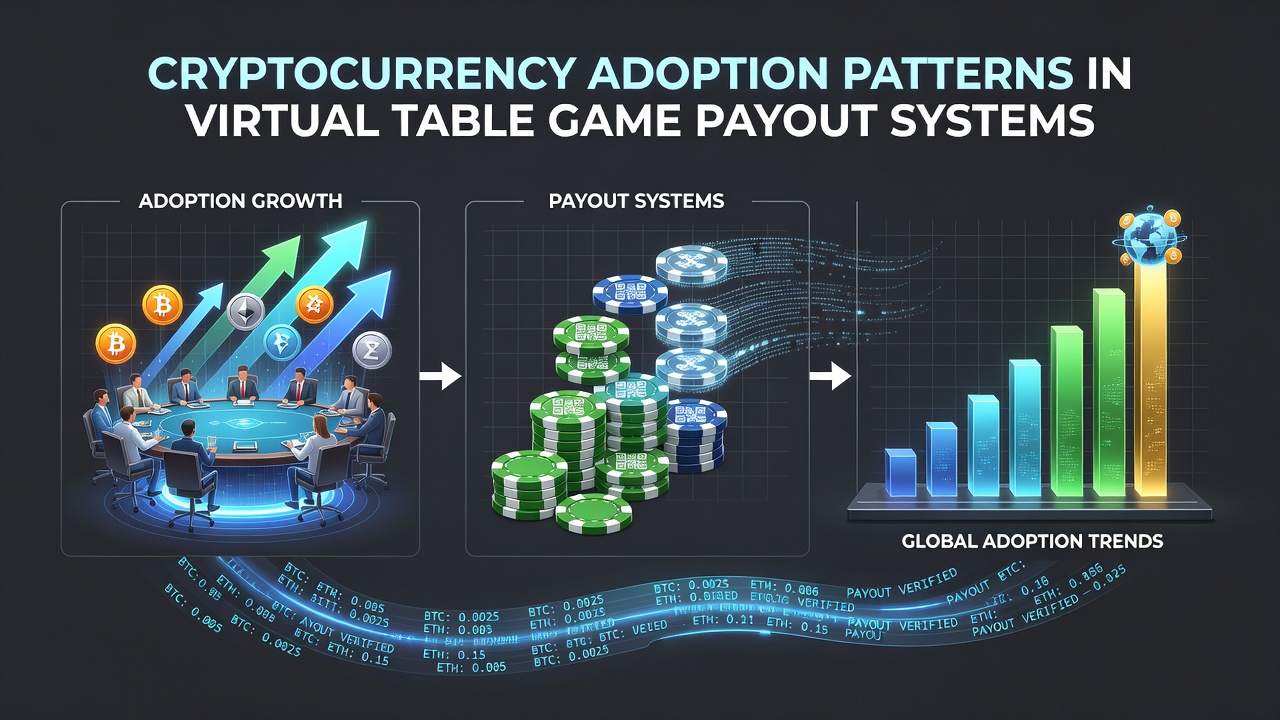
Virtual table game payout systems have incorporated cryptocurrency options at a steady pace since the early 2020s, with transaction data showing distinct regional and platform-specific patterns that continued through August 2026. Platforms handling blackjack, roulette, and poker variants reported that Bitcoin and Ethereum transfers accounted for roughly 18 percent of total payout volume in monitored markets, while stablecoin usage climbed to 12 percent during the same period according to aggregated industry figures.
Regional Variations in Adoption Rates
North American operators documented faster integration of wallet-based withdrawals compared with European counterparts, although both areas saw measurable shifts after regulatory clarifications issued in late 2025. Canadian platforms, for instance, processed a higher share of USDC payouts in virtual table environments than their Australian equivalents, where AUD-pegged tokens remained secondary to traditional banking rails. Research from the Canadian Gaming Association highlighted that operators in Ontario recorded a 27 percent year-over-year increase in crypto payout requests between September 2025 and August 2026, driven largely by players seeking same-day settlement rather than multi-day bank transfers.
Asian markets displayed different trajectories, with several Southeast Asian licensed sites reporting elevated Ethereum usage for high-limit poker payouts while maintaining fiat rails for lower-stakes blackjack tables. Observers note that transaction speed and reduced intermediary fees served as primary drivers across these jurisdictions, although network congestion during peak hours occasionally offset those advantages.
Technical Infrastructure and Payout Mechanics
Most virtual table game platforms route cryptocurrency payouts through custodial wallets integrated with existing RNG-certified systems, allowing automatic conversion at the moment of cash-out. Smart-contract triggers now handle a growing portion of these disbursements, automatically verifying game outcomes before releasing funds to player addresses. Data from multiple platform audits indicate that average confirmation times for Bitcoin payouts fell from 47 minutes in early 2025 to 19 minutes by mid-2026 after wider adoption of layer-two scaling solutions.

Stablecoins such as USDT and USDC gained particular traction in regions with volatile local currencies, because their price stability reduced the risk of value fluctuation between game completion and withdrawal approval. Several operators introduced optional on-chain verification logs that players could review independently, adding transparency without altering core payout logic.
Player Behavior and Platform Responses
Usage logs reveal that repeat players in virtual poker environments adopted crypto payouts more readily than casual roulette participants, with session-frequency data showing crypto users returning 1.4 times more often than those relying solely on bank transfers. Platforms responded by expanding supported networks to include Polygon and Solana alongside established chains, thereby lowering gas fees for smaller table-game winnings. Industry reports compiled by the European Gaming and Betting Association documented that multi-chain support correlated with a 22 percent rise in average payout requests per active account during the first half of 2026.
Security protocols evolved in parallel, incorporating multi-signature requirements and address whitelisting that players activate before initiating withdrawals. These measures addressed earlier incidents of address reuse and helped maintain compliance with evolving anti-money-laundering directives across multiple jurisdictions.
Regulatory and Compliance Developments
By August 2026, several licensing authorities had updated their technical standards to include explicit requirements for on-chain audit trails in crypto-enabled payout systems. Operators that failed to maintain immutable transaction records faced extended review periods before license renewals. Academic papers published through the University of Nevada’s gaming research center examined how these compliance layers influenced adoption speed, finding that clearer guidelines accelerated integration while ambiguous rules slowed it.
Tax reporting mechanisms also matured, with platforms automatically generating standardized transaction summaries that players could export for local revenue authorities. This functionality reduced administrative friction and encouraged wider participation among users previously hesitant due to record-keeping concerns.
Future Trajectory Indicators
Transaction volume forecasts released by research firms project continued moderate growth through 2027, contingent on further improvements in cross-chain interoperability and regulatory harmonization. Early indicators from August 2026 already show increased stablecoin preference among high-volume table-game players, suggesting that platforms may prioritize those assets in upcoming payout feature updates.
Conclusion
Patterns observed through August 2026 illustrate that cryptocurrency adoption in virtual table game payouts follows a measured rather than explosive trajectory, shaped by regional regulation, technical scalability, and player preferences for speed and cost efficiency. Continued monitoring of transaction data and compliance frameworks will determine how these systems evolve in subsequent periods.